Indexes into negList (negative index) or posList (zero or positive index). More...
Public Member Functions | |
| BiIndirectList (const UList< T > &posList, const UList< T > &negList, const labelUList &addr) | |
| Construct given the complete lists and the addressing array. More... | |
| BiIndirectList (const UList< T > &posList, const UList< T > &negList, labelList &&addr) | |
| Construct given the complete list and by transferring addressing. More... | |
| bool | empty () const noexcept |
| True if the list is empty (ie, size() is zero). More... | |
| label | size () const noexcept |
| The number of elements in the list. More... | |
| const UList< T > & | posList () const noexcept |
| The list of positive values (without addressing) More... | |
| const UList< T > & | negList () const noexcept |
| The list of negative values (without addressing) More... | |
| const labelList & | addressing () const noexcept |
| The addressing used for the list. More... | |
| void | resetAddressing (const labelUList &addr) |
| Copy reset addressing. More... | |
| void | resetAddressing (labelList &&addr) |
| Move reset addressing. More... | |
| void | extract (UList< T > &result) const |
| Extract the addressed elements. Sizes must match! More... | |
| List< T > | list () const |
| Extract and return the addressed elements as a List. More... | |
| List< T > | operator() () const |
| Extract and return the addressed elements as a List. More... | |
| T & | operator[] (const label i) |
| Return non-const access to an element. More... | |
| const T & | operator[] (const label i) const |
| Return const access to an element. More... | |
| void | operator= (const T &val) |
| Assignment of all entries to the given value. More... | |
| void | operator= (Foam::zero) |
| Assignment of all entries to zero. More... | |
| void | operator= (const UList< T > &vals) |
| Deep copy values from a list of the addressed elements. More... | |
Static Public Member Functions | |
| static label | posIndex (const label i) noexcept |
| Calculate index given whether index is into posList or negList. More... | |
| static label | negIndex (const label i) noexcept |
Indexes into negList (negative index) or posList (zero or positive index).
Definition at line 49 of file BiIndirectList.H.
|
inline |
Construct given the complete lists and the addressing array.
Definition at line 27 of file BiIndirectListI.H.
Construct given the complete list and by transferring addressing.
Definition at line 41 of file BiIndirectListI.H.
|
inlinenoexcept |
True if the list is empty (ie, size() is zero).
Definition at line 90 of file BiIndirectList.H.
References UList< T >::empty().

|
inlinenoexcept |
The number of elements in the list.
Definition at line 95 of file BiIndirectList.H.
References UList< T >::size().

The list of positive values (without addressing)
Definition at line 100 of file BiIndirectList.H.
The list of negative values (without addressing)
Definition at line 105 of file BiIndirectList.H.
|
inlinenoexcept |
The addressing used for the list.
Definition at line 110 of file BiIndirectList.H.
|
inlinestaticnoexcept |
Calculate index given whether index is into posList or negList.
Definition at line 115 of file BiIndirectList.H.
|
inlinestaticnoexcept |
Definition at line 116 of file BiIndirectList.H.
|
inline |
Copy reset addressing.
Definition at line 56 of file BiIndirectListI.H.
|
inline |
Move reset addressing.
Definition at line 63 of file BiIndirectListI.H.
Extract the addressed elements. Sizes must match!
Definition at line 70 of file BiIndirectListI.H.
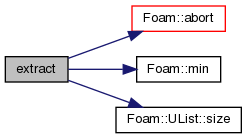
References Foam::abort(), Foam::FatalError, FatalErrorInFunction, FOAM_UNLIKELY, Foam::min(), Foam::nl, and UList< T >::size().
|
inline |
Extract and return the addressed elements as a List.
Definition at line 92 of file BiIndirectListI.H.
References Foam::extract().

|
inline |
Extract and return the addressed elements as a List.
Definition at line 103 of file BiIndirectListI.H.
References Foam::extract().

|
inline |
Return non-const access to an element.
Definition at line 112 of file BiIndirectListI.H.
|
inline |
Return const access to an element.
Definition at line 121 of file BiIndirectListI.H.
|
inline |
Assignment of all entries to the given value.
Definition at line 131 of file BiIndirectListI.H.
|
inline |
Assignment of all entries to zero.
Definition at line 143 of file BiIndirectListI.H.
Deep copy values from a list of the addressed elements.
Definition at line 155 of file BiIndirectListI.H.
References Foam::abort(), Foam::FatalError, FatalErrorInFunction, FOAM_UNLIKELY, and UList< T >::size().

 1.8.14